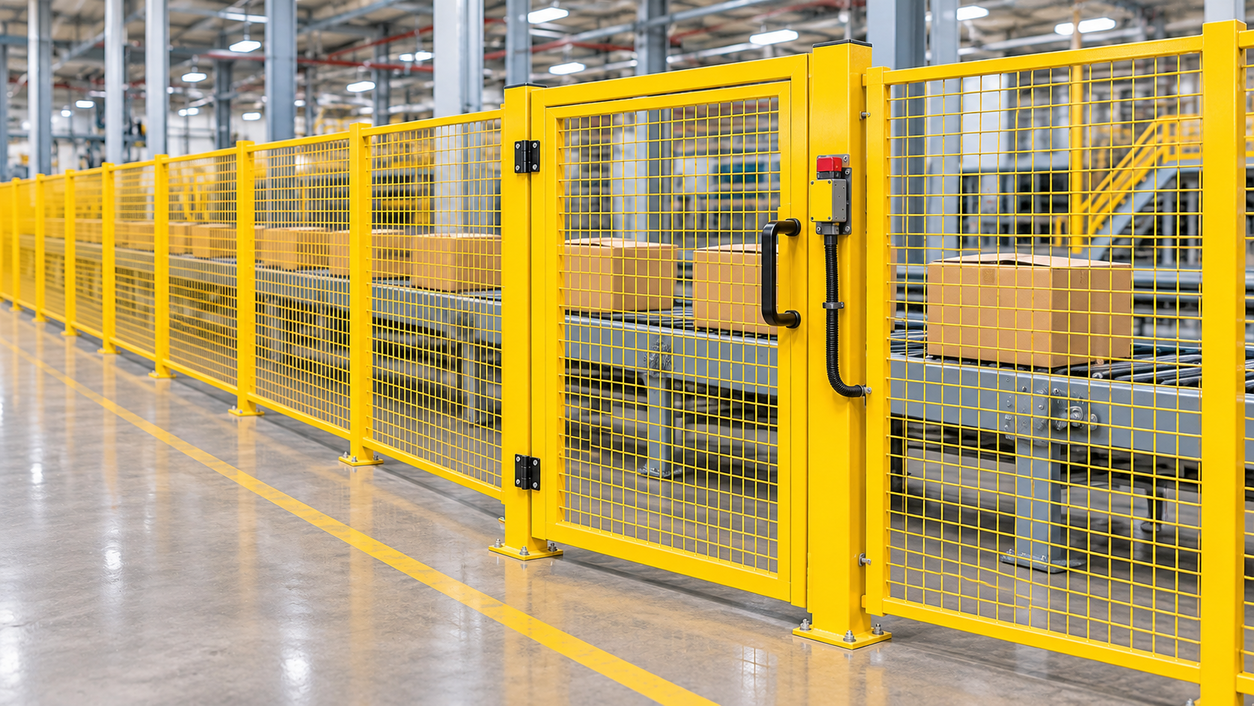
Conveyor safety fencing is a physical guarding system, usually mesh panels, posts and gates, installed along and around conveyors to keep people away from moving parts such as nip points, drive units and pulleys. It is one layer of conveyor protection, used together with conveyor guards and gates.
- Fencing keeps people out of an area, guards cover specific moving parts, and gates control entry. Most conveyors need more than one.
- Gaps are the weak point: openings for product, gate edges and frame clearances need the same care as the panels.
- Frequent access needs interlocked gates, not bolt-on panels.
- Specify from a risk assessment and a drawing, not a catalogue size.
Why conveyors need guarding
A conveyor looks slow and harmless, but it runs continuously and does not stop when something is caught. WorkSafe New Zealand’s conveyor guarding guidance says most serious accidents and fatalities involving conveyors result from inadequate guarding between the belt and parts such as discharge plates and rollers, pulleys, idler pulleys, the conveyor frame, projecting shafts, and belt cleats and fasteners. The harm it lists is trapped hands, cuts, crush injuries and entanglement.
People most often reach into a conveyor to clear a jam, clean, lubricate or adjust it. Those are the moments where fixed fencing, guards and interlocked access matter most.
Fencing, guards and gates: three layers of protection
| Layer | What it protects | Typical use |
|---|---|---|
| Conveyor safety fencing | The area around a conveyor or a hazardous zone | Mesh panels and posts along the line, keeping people clear |
| Conveyor guards | A specific moving part such as a pulley, roller or drive | Covers at nip points and transmission parts |
| Conveyor safety gates | Controlled entry through the fence | Access for operators and maintenance, ready for interlock switches |
In short, a fence keeps people out of an area, a guard stops contact with a part, and a gate controls the way in. Learn more about conveyor safety fencing, conveyor guards and conveyor safety gates.
The parts of a conveyor safety fence
- Mesh panels: keep people back while letting you see the conveyor and the product.
- Posts: hold the panels in line and fix the fence to the floor or structure.
- Gates and doors: placed where operators or maintenance must enter, with provisions for safety interlock switches.
- Product openings: cut-outs where the conveyor enters and leaves the fenced zone, made to your product size and position.
- Finish: our fencing is made in mild steel (MS) and powder-coated.
Where conveyor safety fencing is used
- Warehouses and logistics
- Packaging lines
- Automotive and auto-component plants
- Manufacturing and assembly lines
- Pharma and FMCG packing lines
- Palletizing lines
How to specify conveyor safety fencing
- Find the hazards. Walk the line with a risk assessment and mark every point a person can reach. See conveyor nip points explained.
- Set length and height from the hazards and your risk assessment. Standards such as ISO 13857 give safety distances.
- Plan product openings. Every opening is a gap, so keep it as small as the product allows.
- Place gates where people really need access, such as near drives and jam points.
- Choose interlocks. Where access is frequent, gates should carry interlock switches wired to your safety circuit.
- Confirm fixing and finish against your floor and layout drawing.
See conveyor safety standards for how the standards fit together.
Common mistakes to avoid
- Guarding the head pulley but leaving the tail pulley and return rollers exposed.
- Leaving open gaps at product openings or between panels and the frame.
- Using tool-secured panels where access is frequent. WorkSafe New Zealand’s conveyor guarding guidance accepts them only if access is needed no more than once per shift; otherwise guards should be interlocked to the power control.
- Forgetting lubrication and tensioning points, which are better grouped outside the guards.
- Letting people cross conveyors. WorkSafe NZ advises that people never ride on or cross conveyors, and that crossovers have stairs and handrails.
Fencing is not the only control
Fencing works alongside other controls. WorkSafe New Zealand’s conveyor guarding guidance also lists stop and start controls, including emergency stops, within reach of the operator; audible and visible warnings before the conveyor moves when the start position is out of sight; lock-out for cleaning and repairs; training; and no ties, loose clothing or gloves near moving parts. It also notes that this guidance pre-dates current New Zealand legislation, so read it as general good practice.
How Devidatt Enterprises can help
We are a Pune-based manufacturer of conveyor safety fencing, conveyor guards and conveyor safety gates, made to your conveyor drawing, photos or site measurements and installed across India. Send your layout to info@conveyorsafetyfencing.com or on WhatsApp for a priced proposal, usually within one working day.
Common questions
What is conveyor safety fencing?
Conveyor safety fencing is a physical guarding system, usually mesh panels, posts and gates, installed along and around conveyors to keep people away from moving parts.
Does every conveyor need a safety fence?
Not always. The protection needed depends on a risk assessment. Guards cover nip points, and fencing with gates keeps people out of hazardous zones. Where people can reach moving parts, guarding is normally needed.
What is the difference between conveyor fencing and conveyor guards?
Fencing keeps people away from a wider area. Guards cover specific moving parts and nip points. Many conveyors use both.
Can fencing be added to an existing conveyor?
In many cases, yes. Send us your drawing, photos or site measurements and we will advise on a fence made to fit your line.
What affects the price of conveyor safety fencing?
Price depends mainly on fence length and height, the number of gates, product openings, interlock provisions and installation. Send a drawing for a priced proposal.
Send your conveyor layout to info@conveyorsafetyfencing.com or on WhatsApp. See our conveyor safety fencing, conveyor guards and conveyor safety gates.
Keep reading: